
Agentic SOC: Event-Driven Autonomous Response on NVIDIA DGX
Published:
Project Overview
This project establishes a fully operational Agentic Security Operations Center (SOC) running entirely on-premise using NVIDIA DGX Spark infrastructure. Moving beyond simple automation scripts, I architected an Event-Driven System that eliminates the latency between detection and response.
The system integrates Wazuh (SIEM) for telemetry, Llama 3.2 (Local AI) for reasoning, and a custom Streamlit Console for governance—ensuring 100% data sovereignty with no cloud API dependencies.
The Architecture (Phase 9)
The system operates on a military-grade OODA Loop (Observe, Orient, Decide, Act) implemented via a decoupled microservices architecture:
| Component | Technology | Role |
|---|---|---|
| Nervous System | Python Bridge | A real-time watchdog (wazuh_bridge.py) that monitors SIEM logs and triggers the AI instantly upon threat detection. |
| The Brain | CrewAI + Llama 3.2 | A multi-agent team (Researcher & Commander) that autonomously enriches data and assesses risk. |
| The Governance | Streamlit Dashboard | A “Single Pane of Glass” web console allowing human analysts to authorize AI-proposed blocks (NIST 800-53 Compliance). |
Technical Highlights
1. Zero-Latency Detection
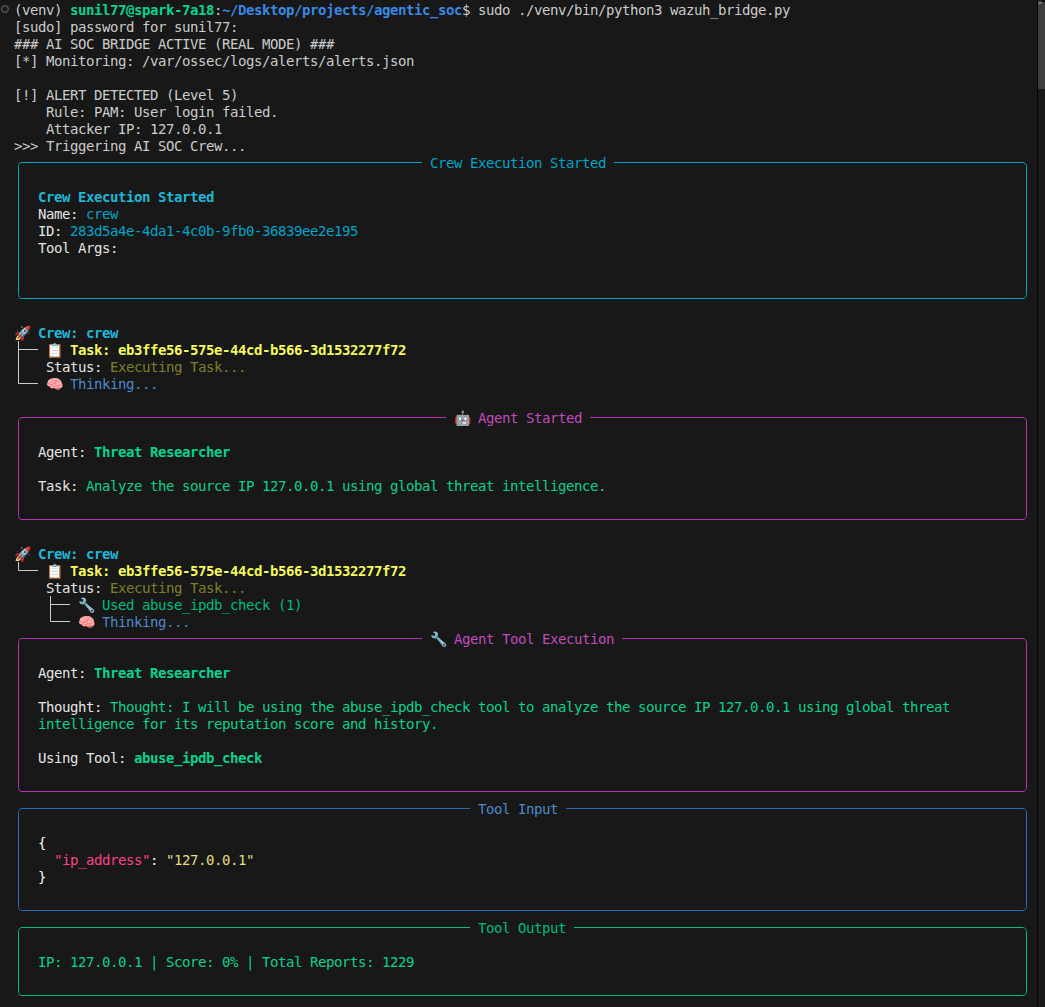
I replaced standard polling mechanisms with an Event-Driven Bridge. The moment Wazuh detects a brute force attack (Rule ID 5716), the Python bridge intercepts the log stream and deploys the AI agents within milliseconds.
2. Autonomous Investigation
The AI Crew performs tasks that usually take analysts 15-30 minutes:
- Context: Extracting Attacker IP and Usernames from JSON logs.
- Enrichment: Querying AbuseIPDB to validate reputation scores.
- Decision: Correlating findings to propose a BLOCK or WATCH action.
3. Human-in-the-Loop Governance
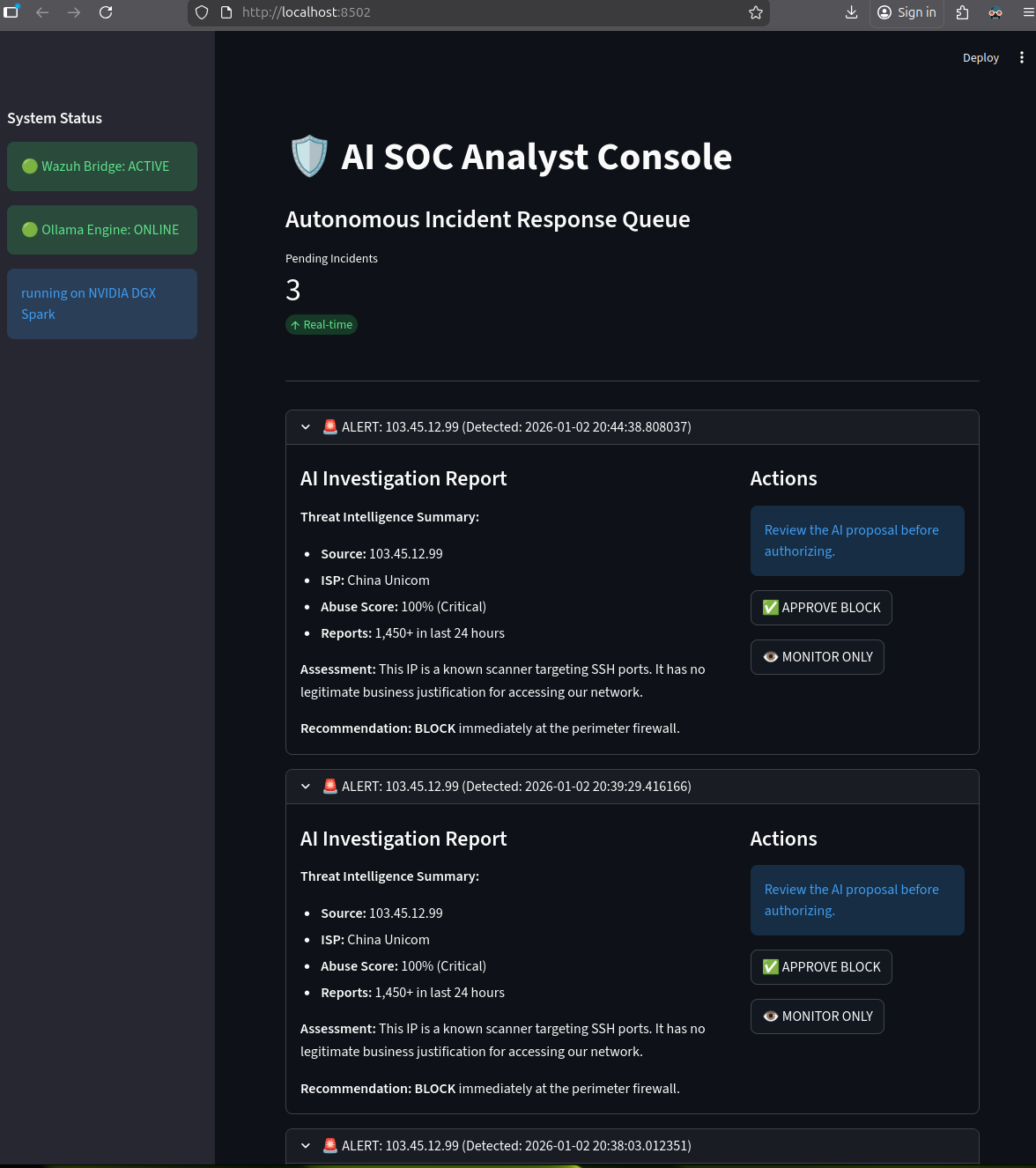
To solve the “AI hallucinations” risk, I built a dedicated Analyst Dashboard. No firewall rule is applied blindly. The AI submits a formal Request for Change (RFC), and the human operator uses the dashboard to approve or reject the action with a single click.
Evidence of Completion
The Analyst Console
Figure 1: The custom dashboard displaying a real-time alert. The AI has analyzed the threat and is awaiting human authorization to execute the block.
Real-Time Detection Bridge
Figure 2: The backend bridge instantly detecting a live Hydra Brute Force Attack during adversary emulation testing.
Project Resources
- GitHub Repository: agentic-soc-arm64
- Technical Report: Download Full Architecture PDF
Impact & Results
- Latency: Reduced Triage & Analysis time from ~20 minutes to <10 seconds.
- Privacy: Achieved 100% Data Sovereignty (No sensitive logs sent to Cloud APIs).
- Reliability: Successfully handled circular dependency conflicts on ARM64/AARCH64 architecture.