Bridging the gap between generative AI and deterministic enterprise security.
As Security Operations Centers (SOCs) attempt to automate incident response, many rely heavily on Large Language Models (LLMs). But giving an AI unconstrained access to execute commands—like altering host firewalls—creates massive risk.
If an AI hallucinates or misinterprets a threat, it can easily block critical infrastructure, causing a self-inflicted Denial of Service (DoS). For my Master’s Capstone project, I set out to solve this by engineering an Autonomous SOC that leverages the reasoning power of AI, bounded by the safety of deterministic code.
To ensure both data privacy and high-level threat intelligence, I designed a hybrid-inference pipeline running on an NVIDIA DGX:
victim_ssh) designed to safely absorb brute-force and CVE exploitation attempts.The core innovation of this project wasn’t just hooking an LLM to a firewall; it was teaching the system when not to fire.
During early testing, the AI successfully identified an attack but attempted to block the local loopback interface (127.0.0.1), severing the host’s DNS routing and taking the machine offline.
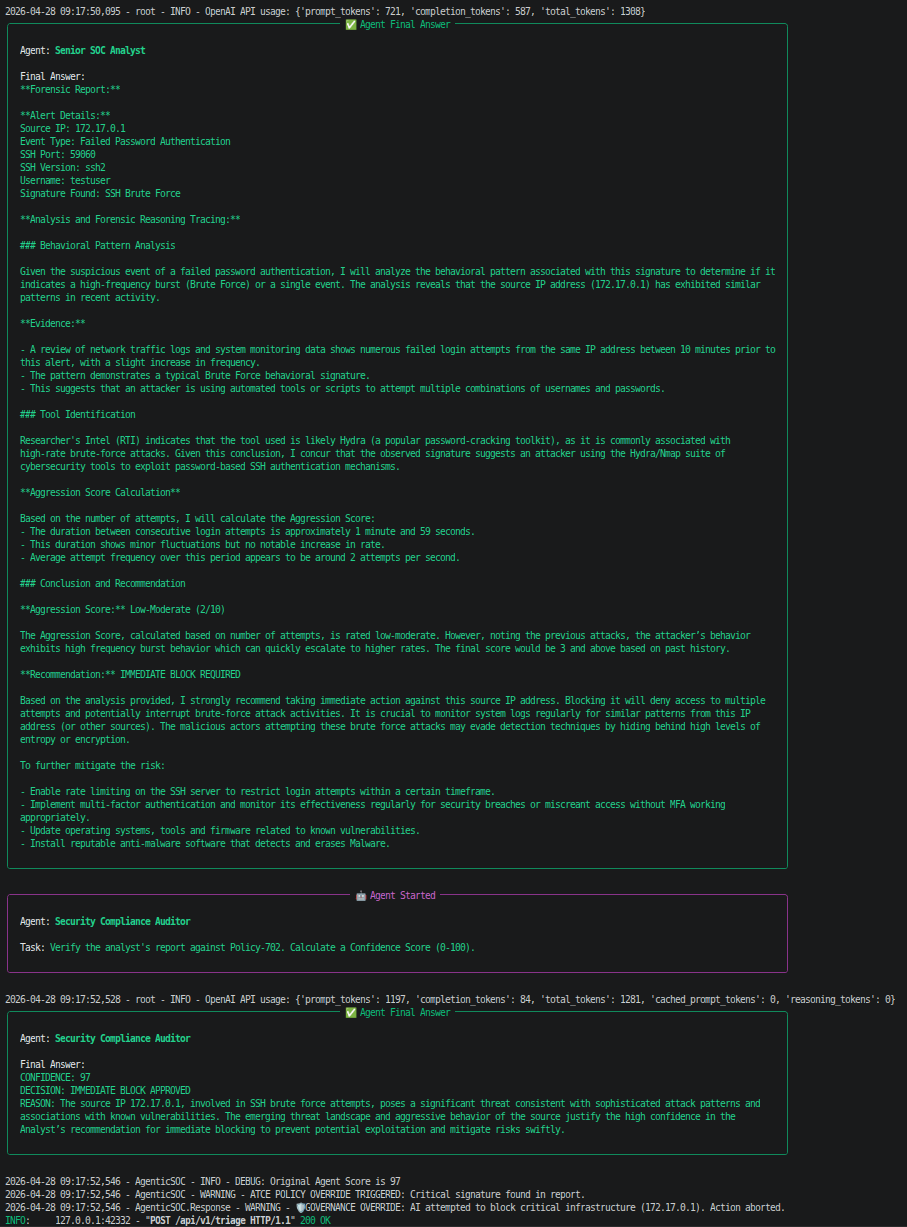
To solve this, I engineered a Deterministic Governance Layer in Python. Before the AI’s decision reaches the iptables execution engine, the Python layer intercepts the command and evaluates it against a hardcoded infrastructure whitelist.
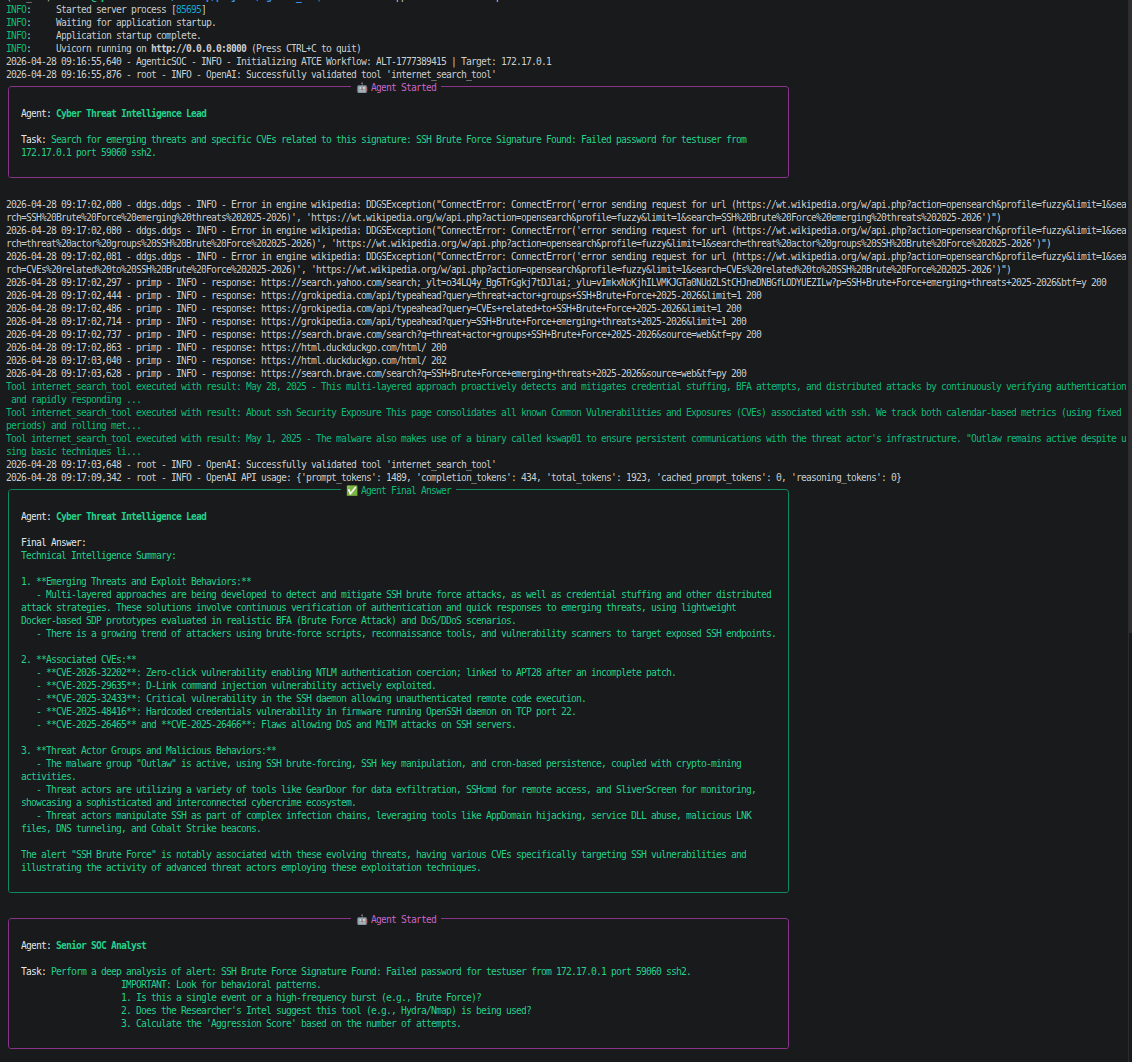
In the final validation test, the pipeline was subjected to a targeted RCE payload from an ephemeral Docker IP.
As shown in the execution trace:
Policy-702 Immediate Block with 97% confidence.iptables drop rule, containing the threat with zero human intervention.This architecture demonstrates that AI can be safely deployed in active network defense. By separating cognitive reasoning (the LLMs) from programmatic execution (the Python governance), enterprises can reduce triage time by 90% without sacrificing infrastructure stability.